


Starting transcranial magnetic stimulation begins with finding an accredited clinical provider and verifying that the protocol matches your diagnostic history. TMS is an FDA-cleared, noninvasive outpatient brain stimulation therapy designed to treat conditions like treatment-resistant depression and obsessive-compulsive disorder without systemic medication side effects.
At the Center for Psychiatric Wellness, TMS forms an integral part of comprehensive psychiatric care that may incorporate clinical assessments, medication management, and supportive psychotherapy.
Before scheduling your initial visit, understanding clinical eligibility, treatment timelines, safety precautions, and insurance authorization ensures a seamless intake process. Below is what to evaluate before your consultation.
Key Takeaways
- TMS requires a clinical evaluation to determine whether treatment is appropriate and safe.
- Treatment usually involves repeated outpatient sessions, often 5 days per week for several weeks.
- Safety, eligibility, and cost vary based on your medical history, treatment protocol, and insurance coverage.
How Do You Find the Right TMS Provider?
Finding the right clinic requires evaluating medical expertise rather than convenience alone. A reputable provider must conduct an initial psychiatric evaluation to determine if neuromodulation fits your clinical history. For patients evaluating regional care, TMS therapy in Fort Smith offers comprehensive outpatient treatment paired with thorough safety screening and ongoing symptom tracking.
Start by checking whether the clinic offers repetitive TMS, also called TMS. Then ask which device the clinic uses and what conditions that device is FDA-cleared to treat.
The evaluation should be completed by a qualified medical professional. The clinician may review the diagnosis, previous treatments, current medications, neurological history, seizure history, and implanted devices.
That review helps determine whether TMS is appropriate.
Treatment schedules are another practical point. Many TMS courses involve visits several days each week for several weeks. A clinic that is farther away may still be practical if its schedule fits the patient’s needs. On the other hand, a nearby clinic may be difficult to use if appointment times do not fit.
What Should You Ask Before Booking?
Before booking a consultation, ask a few direct questions.
- Which TMS device is used?
- What condition is it FDA-cleared to treat?
- Who performs the evaluation?
- How is safety checked?
- How is treatment progress tracked?
- What happens if symptoms do not improve?
The provider should also explain the treatment schedule. Ask how many visits are expected and how long each session usually takes.
Cost should be discussed early, too. Ask whether the initial psychiatric evaluation, treatment sessions, and follow-up visits are billed separately.
And ask about insurance before treatment starts.
Why Does Specialist Assessment Matter?
TMS is a medical treatment. An online form cannot replace a clinical assessment.
The clinician needs to understand the patient’s diagnosis and treatment history. This may include previous antidepressant medications, side effects, other psychiatric treatments, neurological conditions, seizure history, and current symptoms.
Safety screening is also important. The FDA provides device specific warnings and precautions for TMS treatment. Some implanted devices or metal objects near the head can affect eligibility.
A clinician can also explain the difference between an FDA-cleared use and a treatment being studied in research. Those are not the same.
That distinction can make the consultation much clearer.
Could TMS Be an Option for Your Condition?

TMS is used for specific medical conditions. Major depressive disorder is one of the main psychiatric indications. Certain TMS devices also have FDA clearance for obsessive-compulsive disorder.
The exact indication depends on the device and protocol. A diagnosis by itself does not determine whether TMS is appropriate.
For major depressive disorder, FDA-cleared TMS systems include indications for certain adults who have not improved enough with previous antidepressant treatment. The specific requirements can vary by device.
OCD also has an FDA-cleared TMS indication for certain systems. Other psychiatric and neurological conditions have been studied in clinical research, but research use should not be confused with an FDA-cleared indication.
When Is TMS Used for Depression?
TMS therapy for depression may be considered when major depressive disorder has not improved enough with standard treatment. Previous antidepressant treatment is often part of the clinical history reviewed before TMS.
Treatment resistant depression generally describes depression that has not responded adequately to appropriate treatment. The clinician still needs to review the patient’s history before deciding whether TMS is suitable.
A 2007 randomized study examined TMS in adults with major depression who had not improved adequately with previous treatment. Participants received treatment five days per week for four to six weeks. The study found greater improvement with active TMS than with sham treatment on the main depression measure.
That result does not mean every patient will respond in the same way.
Response can vary. Diagnosis, symptoms, previous treatment, treatment settings, and attendance can all matter.
What Other Conditions Are Discussed in TMS Research?
TMS has been studied for several psychiatric and neurological conditions. The amount of evidence and FDA clearance can differ between conditions.
| Condition | What to know |
| Major depressive disorder | Established FDA cleared uses |
| OCD | FDA cleared for certain TMS systems |
| PTSD | Studied in clinical research |
| Migraine | Studied in clinical research |
| Stroke recovery | Studied in clinical research |
| Parkinson’s symptoms | Studied in clinical research |
| Tinnitus | Studied in clinical research |
The device matters. So does the protocol.
For example, the FDA cleared a BrainsWay Deep TMS system for OCD in 2018 after reviewing clinical data. That clearance applies to the specific device and indication. It should not be treated as evidence that every TMS system has the same clearance.
A clinician can explain whether a proposed treatment is FDA-cleared or is being used based on research evidence.
What Does a TMS Session Feel Like?
During TMS, an electromagnetic coil is placed against the scalp. The coil delivers magnetic pulses to a selected area of the brain.
The patient stays awake. There is no general anesthesia for standard TMS treatment.
The machine makes clicking sounds during stimulation. Some patients feel tapping, pressure, or mild discomfort around the treatment area. The sensation can change depending on the device, treatment target, and stimulation settings.
The first appointment may take longer than later sessions because the clinician needs to establish the treatment position and stimulation level.
How Long Does TMS Treatment Take?
Session length depends on the treatment protocol.
“A typical TMS session usually lasts anywhere from 3–40 minutes. A typical course of TMS treatment consists of daily sessions 5 days per week for 4–6 weeks.” – National Institute of Mental Health (NIMH)
Other protocols can be shorter. Theta burst stimulation, for example, uses shorter daily intervals than conventional TMS protocols. You can explore our guide on how many sessions of TMS are needed to better understand standard treatment calendars and frequency. The treating clinician selects the protocol based on the device, indication, clinical evidence, and individualized treatment plan.
Can Patients Work or Drive After TMS?

TMS does not normally require anesthesia or sedation. Patients remain awake during treatment and can usually return to regular activities afterward.
Mayo Clinic states that patients can generally drive and work after TMS. Individual medical advice may differ if a patient develops a headache, lightheadedness, or another significant symptom.
The clinician should be contacted if an unexpected reaction occurs.
A patient should also follow any specific instructions provided by the treatment team.
What Should Patients Know About TMS Safety?
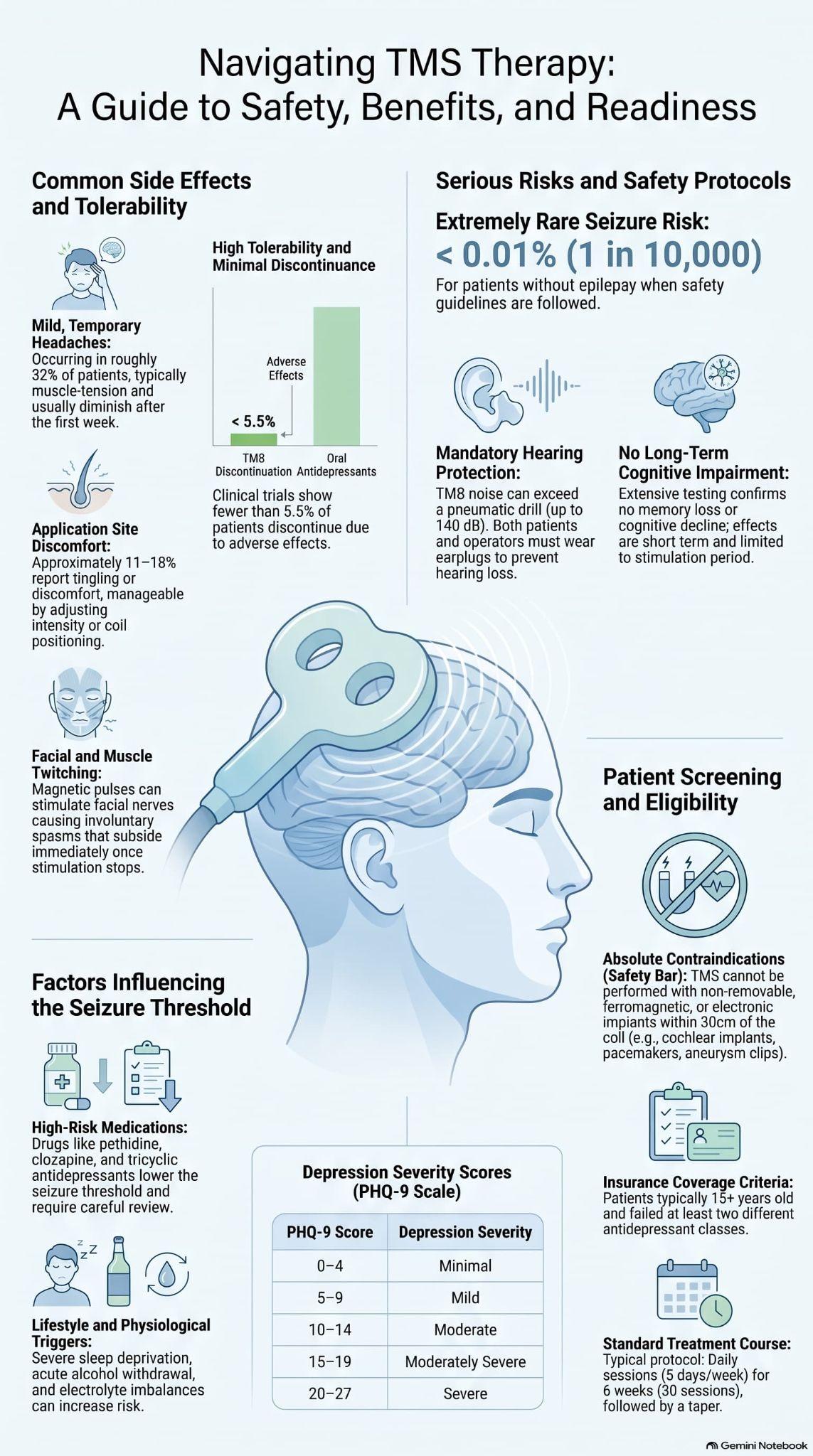
“Generally, TMS is considered safe and well-tolerated. However, it can cause some side effects.” – Mayo Clinic
Common side effects include headache, scalp discomfort, tingling, and facial muscle twitching. Serious complications are uncommon, but seizures and mania can occur.
Patients should tell the clinician about previous seizures, neurological conditions, implanted devices, metal near the head, and medications that may affect seizure risk.
How Much Does TMS Cost?
The cost of TMS varies between patients and clinics. Insurance coverage can also change the amount a patient pays.
Some insurance plans require certain conditions to be met before TMS is covered. For example, the plan may require a specific diagnosis and records of previous treatment.
Before treatment starts, the clinic can review the expected cost with the patient. The financial team may also check insurance benefits and authorization requirements.
A written estimate can help.
What Happens If Symptoms Do Not Improve?
Early changes are not the same for every patient. Some patients may notice improvement during treatment. Others may need more time.
If symptoms remain, the clinician may review several parts of the treatment plan. This can include the number of sessions, treatment settings, attendance, current medications, and the original diagnosis.
And sometimes the plan needs to change.
Additional TMS sessions may be discussed in some cases. The clinician may also review medication, counseling, or another treatment option.
TMS does not have to replace other psychiatric care. It can be one part of a larger treatment plan.
Starting TMS Treatment
Starting TMS begins with a clinical evaluation, not simply choosing the closest provider. The right clinic should review safety, explain the treatment schedule, and discuss expected costs. Your needs come first.
Center for Psychiatric Wellness offers TMS as part of broader psychiatric care. A consultation can help determine whether TMS may be appropriate and what treatment options fit your situation.
If you or a loved one are experiencing severe depression symptoms, thoughts of self-harm, or an immediate mental health crisis, call or text 988 to connect with the Suicide & Crisis Lifeline, or seek emergency medical care immediately.
FAQs
How often will I need to visit a TMS treatment center near me?
Standard transcranial magnetic stimulation typically follows a 4 to 6-week protocol, requiring brief outpatient sessions five days per week. Because consistency directly influences clinical response, choosing a facility with an accessible daily commute helps prevent missed appointments and supports uninterrupted therapeutic outcomes.
Does TMS treatment require anesthesia or downtime?
No, standard TMS is an entirely noninvasive, outpatient procedure that requires no general anesthesia, sedation, or recovery window. Patients remain awake and alert in a comfortable treatment chair throughout the session and can immediately return to work, school, or their normal daily routine.
Which mental health conditions are FDA-cleared for TMS?
The FDA has cleared repetitive TMS primarily for adults with major depressive disorder who have not found adequate relief from standard antidepressant medications. Certain specialized devices also hold FDA clearance for obsessive-compulsive disorder (OCD) and smoking cessation, while applications for conditions like PTSD and bipolar depression remain under active clinical investigation.
Can I drive myself home after a TMS appointment?
Yes, the vast majority of patients drive themselves to and from their TMS visits. Because the therapy does not involve systemic sedatives or cognitive impairment, driving remains safe. However, if you experience a temporary mild tension headache or slight lightheadedness after an initial session, your clinician may advise pausing briefly before driving.
Does health insurance cover the cost of TMS treatment?
Most major commercial insurance carriers, Medicare, and Tricare provide coverage for TMS treatment of major depressive disorder when clinical criteria are met. In general, insurers require documented evidence of treatment-resistant depression, typically defined as trials of two or more antidepressant medications without satisfactory improvement. Your clinic’s administrative team usually coordinates directly with your insurer to manage benefits verification and prior authorization before treatment begins.
Can TMS therapy be combined with antidepressants or counseling?
Yes, TMS does not require you to discontinue existing psychiatric care. In fact, neuromodulation often works synergistically alongside ongoing psychotherapy and tailored medication regimens. Any adjustments to your current prescriptions should only occur under the direct supervision of your prescribing psychiatrist.
References
- https://www.nimh.nih.gov/health/topics/brain-stimulation-therapies/brain-stimulation-therapies
- https://www.mayoclinic.org/tests-procedures/transcranial-magnetic-stimulation/about/pac-20384625


